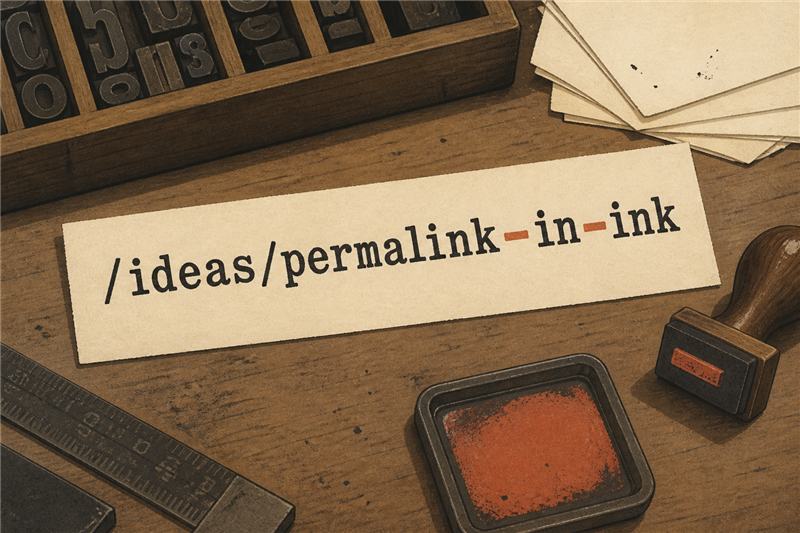
People still read URLs
Not everyone. Not always. But the ones who hover, who paste a link into a doc, who check whether you look like spam — they glance at the path. A clean slug is a small trust signal.
Instant · Private · In the browser
Free slug generator
Free slug generator for URL slugs and permalinks. Type a headline, a product name, a video title — the slug updates as you type. Copy it into WordPress, Shopify, or any permalink field. Nothing is uploaded.
More tools
Same engine. Different filename, so search can tell a WordPress permalink from a Shopify handle from a bulk list.
Why this exists
You finish the draft, hit publish, and the CMS quietly turns your H1 into a 140-character monster with dates, brackets, and a trailing question mark. Then that URL shows up in Slack, in search, on a screenshot someone tweets two years later. This box is here so you can fix the path before it calcifies.
Not everyone. Not always. But the ones who hover, who paste a link into a doc, who check whether you look like spam — they glance at the path. A clean slug is a small trust signal.

When a preview fails, the raw URL is what people see. best-cast-iron-skillet looks like a page. img_4921-final-FINAL2 looks like a leftover file.

Google has said hyphens help it see words in a URL. That isn’t a ranking cheat code. It’s closer to labeling a folder so a human (or a crawler) can tell what’s inside.
Specimen
Same article. Two paths. One you can say out loud without wincing.
| Title you wrote | What a CMS often keeps | What to publish |
|---|---|---|
| How to Season a Cast Iron Skillet (Without the Smoke Alarm) | how-to-season-a-cast-iron-skillet-without-the-smoke-alarm |
season-cast-iron-skillet |
| 10 Best Coffee Grinders for Small Kitchens (2026 Guide) | 10-best-coffee-grinders-for-small-kitchens-2026-guide |
best-coffee-grinders-small-kitchens |
| We Tried IKEA’s $40 Desk Lamp. Here’s the Honest Take. | we-tried-ikeas-40-desk-lamp-heres-the-honest-take |
ikea-40-desk-lamp-review |
| Q3 Revenue & Headcount — Board Deck | q3-revenue-headcount-board-deck |
q3-revenue-headcount |
The generator will strip filler words if you leave that box checked. It will not invent a better title. That’s still on you.
How it thinks
São Paulo becomes sao-paulo. Café becomes cafe. That’s usually what you want in a URL that has to survive email clients and old CMS fields.
IKEA’s becomes ikeas, not ikea-s. Don’t looks like dont. A little ugly. Better than a stray quote breaking a path.
Words like the, for, and, with get dropped when the box is on. If stripping would leave you with nothing, the tool keeps the original words.
The cap tries to cut on a separator, not in the middle of a word. Default is 75. You can raise it. You probably shouldn’t.
I used to leave permalinks on auto. WordPress would swallow the whole H1, including the joke in the parentheses, and I’d tell myself I’d tidy it later. Later never came. Then a roundup site linked to the long version, and changing it meant a redirect I also forgot to add. The page still ranks. The URL still looks like a first draft.
A slug is not a headline. Headlines sell the click. Slugs label the object. If the article is a review of a cheap IKEA lamp, the slug can just say that. Save the attitude for the H1.
Three to six words is the range I actually use. Enough that a stranger can guess the topic. Short enough that it doesn’t wrap in a mobile address bar. Dates in the slug are a trap unless the page is genuinely tied to a year — a tax guide, a conference recap, a “what changed in 2026” post. Evergreen pieces age badly when the path still says 2024.
Stop words are not evil. They’re just expensive. how-to-fix-a-leaky-faucet works. fix-leaky-faucet works better in a list of 400 posts. I turn filler stripping on for blog posts and off for brand names, because “The North Face” should not become “north-face” unless that’s already how you write it.
If you cannot read the slug aloud in one breath, cut it.
Numbers are fine when they mean something. “10 best” is usually padding. “ISO 27001” is not. Keep product model numbers. Drop the listicle count unless the count is the point of the page.
Publishing is easy. Renaming is not. Every old URL you abandon needs a 301. Miss one and you split traffic, lose comments, and teach search engines that you’re sloppy. If you’re unsure, keep the first slug. A slightly long path you never change beats a “perfect” one you rewrite twice.
Some platforms are worse about this than others. WordPress will offer a redirect if you edit a permalink, then quietly fail if a plugin is fighting it. Shopify lets you change handles; the old one 404s unless you add a redirect yourself. YouTube video URLs are the ID, so the title slug in the extra path is mostly cosmetic — still worth cleaning because it shows under the player and in pasted links.
Underscores are a habit from code and from people who grew up on Windows file names. Search engines have treated hyphens as spaces for a long time. Underscores tend to glue words together. Use _ in a repo if you want. Use - on the open web.
I’ve seen best-crm-software-best-crm-tools-crm-software-2026. Nobody types that. It looks like you’re hiding. Put the topic in once, in the order a person would say it, and stop.
Emoji in URLs look clever in a tweet for about an hour. Then someone pastes the link into Outlook, or a QR generator, or a PDF, and you get percent-encoded garbage. Same story with curly quotes copied out of Google Docs. This generator strips that stuff on purpose. If you need a non-Latin permalink, that’s a different problem — language-specific URLs can work, but only if your whole stack (host, CDN, sitemap, social scrapers) agrees.
Ampersands become “and”. That’s deliberate. q3-revenue-and-headcount is readable. q3-revenue-headcount is shorter. Pick one house style and stick to it so your archive doesn’t look like five people fought over the CMS.
I would not auto-generate slugs from a 40-word SEO title and call it a day. I would not add the category, the author, and the month into the path “for structure.” Folders help humans on big sites. They also lock you into a taxonomy you’ll want to redo. A flat /season-cast-iron-skillet is easier to move than /blog/2026/08/home/kitchen/season-cast-iron-skillet.
And I would not obsess. A clean slug is table stakes. The article still has to be good. This tool just keeps the URL from embarrassing the rest of the work.
House rules
That’s the whole craft, more or less. The generator handles the boring mechanical part: punctuation, case, separators, length. You still have to decide what the page is called when it isn’t performing.
Questions
It’s the last readable chunk of the address. In https://example.com/best-cast-iron-skillet, the slug is best-cast-iron-skillet. Folders before that are a separate choice.
No. The conversion runs in JavaScript on this page. There’s no paste history on a server, because there isn’t a server step. Refresh and it’s gone.
Hyphens for public pages. Underscores if you’re naming a file or a function and that’s the local convention. The toggle is there because people asked for it, not because both are equal on the web.
Short enough to read aloud. I aim for under 60 characters and get nervous after 75. Search results and some apps clip the path, so the useful words should sit up front.
Yes, with a 301 from the old path to the new one. Skip the redirect and you break bookmarks, newsletters, and anyone who printed the link. If the page already has decent links, think twice before renaming it for taste.
No. It gives you a string to paste. See the WordPress slug generator and Shopify slug generator if you need the clicks after you copy. The permalink generator is the same tool with CMS wording.
Yes. The bulk slug generator takes one title per line and returns a matching list of URL slugs. This homepage stays one-at-a-time so you can watch the slug change as you edit.